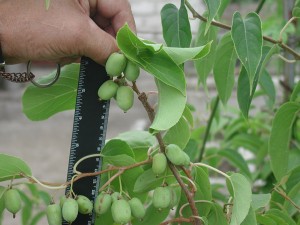
Hardy up to zone 4, super hardy kiwis (or kiwiberries) are vines that produce small tasty berries the size of large grapes. You can expect a yield within 3 – 8 years. They can tolerate a range of soils as long as the area is well-drained but still moist. While less vigorous than the hardy kiwi (actinidia aruguta), they still require a substantial trellis to support their growth. They require a male pollinator, 1 for every 6 – 8 female vines. As wind is the primary pollinator, plant the male to the West or the direction of the prevailing wind.
WARNING: Cats like to eat them and may destroy young vines!
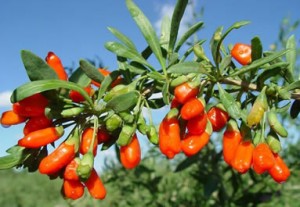
Also known as Wolfberry, Gojo berries can grow is sandy, loamy or clay soils. They require watering during the first year but are drought tolerant after that. They require good drainage and require full sun. They can be grown in zones 2 – 7.
The goji berry grows into a large shrub reaching heights of 7-10 feet with vines that can reach 10 feet. Pruning of the main stem and branches will keep the plant shorter, thicker and help with increased flowering and fruit production.
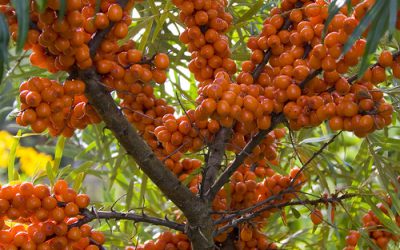
Thornless. Vigorous grower that establishes itself quickly with heavy yields, excellent for home gardens. Semi–erect growth habit, but they require trellising or plant them along a fence. Very disease resistant.
Lighting: sun
Plant Height: 5-7′
Ground Condition: Well drained
Spread: 3-5′
ZONE: I’ve seen 3a – 11 posted online. Most references are zone 5 and up. Winter protection in colder climates seems like it may be necessary.
La Crescent (Japanese-American) is a hardy fast growing tree that produces a freestone plum that is yellow skinned with a slight red blush. Its yellow flesh is aromatic and sweet making it an ideal plum for fresh eating, preserves, drying or canning. It requires a pollinator.
ZONE: I’m not entirely sure. The tag says 5 but other online sources say 3 & 4. Zone 4 seems to be the mostly commonly referenced number.
HARVEST: Early (End of August)
Moderate susceptibility to black knot. Aphids can be a common problem to all plum trees.
Let’s kick off Manitoulin’s first PET day starting at: 11 am this Sunday May 29th (or when you can make it). I hope this is a good day for folks as there is a bike rally on Saturday that I and others are going to. Please RSVP if you can so I know roughly how much food to prepare.
Lunch and snacks will be provided (any restrictions? I know a couple folks are herbivores)
On the List:
pick most appropriate homes for plants:
2 plum trees
1 apple tree
gooseberries (lots!)
blueberries (need to lower the PH of the soil. Any suggestions? (Rotting pine needles? Peat moss?))
does anyone have any dewberries, loganberries, youngberries or marionberries that can be transplanted?
does anyone have any other surplus, multi-functional perennials that could add to the diversity here?
build up some terraces
eat together!
shuttle manure around
move sauna to new home (maybe)
top up raised beds and plant Ruta’s lovingly raised heritage tomatoes
plant, plant, plant (perennials and some annuals)
prune fruit trees (can someone skilled in the art teach this?)
talk about who wants a PET day next
Tools Required:
We only have 1 good wheelbarrow. Can someone supply a second, or third?
Whatever is required to move a small building (the sauna). I think we can pull it with the tractor, perhaps on logs or something else round (open to suggestions here)
I think that is it. If you have any thoughts, suggestions or relevant things to toss in the mix, please do. Feel free to invite anyone you think would enjoy participating.
I’ve been pondering ways to substantially extend the growing season on Manitoulin. My first thought was to build a 2-story earthship across the front of our property. Earthships are typically built for people but I think they would work equally well or perhaps better for aquaculture and agriculture. A 2 story one would have enough space for fish, mushrooms, perennials, annuals and trees and would be passively heated or perhaps require minor supplemental heating. I’m still stoked on this idea but just stumbled into another option with a considerably lighter footprint: geodesic biodomes. I don’t think a dome would extend the season quite as far as an earthship but being (relatively) quick to erect, it could be a good place to start. The aesthetics are quite nice as well which would serve to draw people in which has implicit educational benefits as well.
I will soon be setting up my writing space and committing myself to the task of writing a short book on the Earth’s changing atmosphere(s), based on a survey of all English-language articles about condensation trails, and connected articles on atmospheric h2o, published in scientific journals since the start of the jet age. In this missive to my Manitoulin Permaculture community, I will practice conciseness in retelling what I learned from that survey.
I began my research because I had noticed that the look and behaviour of condensation trails, contrails, was changing. The persisting and spreading contrails we are familiar with today did not exist at the beginning of the jet age. Following the path of the chronological survey we can see that the first persisting and spreading contrails shocked and dismayed observers and in scientific and popular publications from the sixties there can be found articles and photographs of these rare occurrences with much excited speculation as to their identity. Through the seventies and eighties, new nomenclature is installing itself in the journals on atmospheric physics and after 2000 there is regular use of a term for a NEW ‘species’ of cloud – the “Jet Cirrus”.